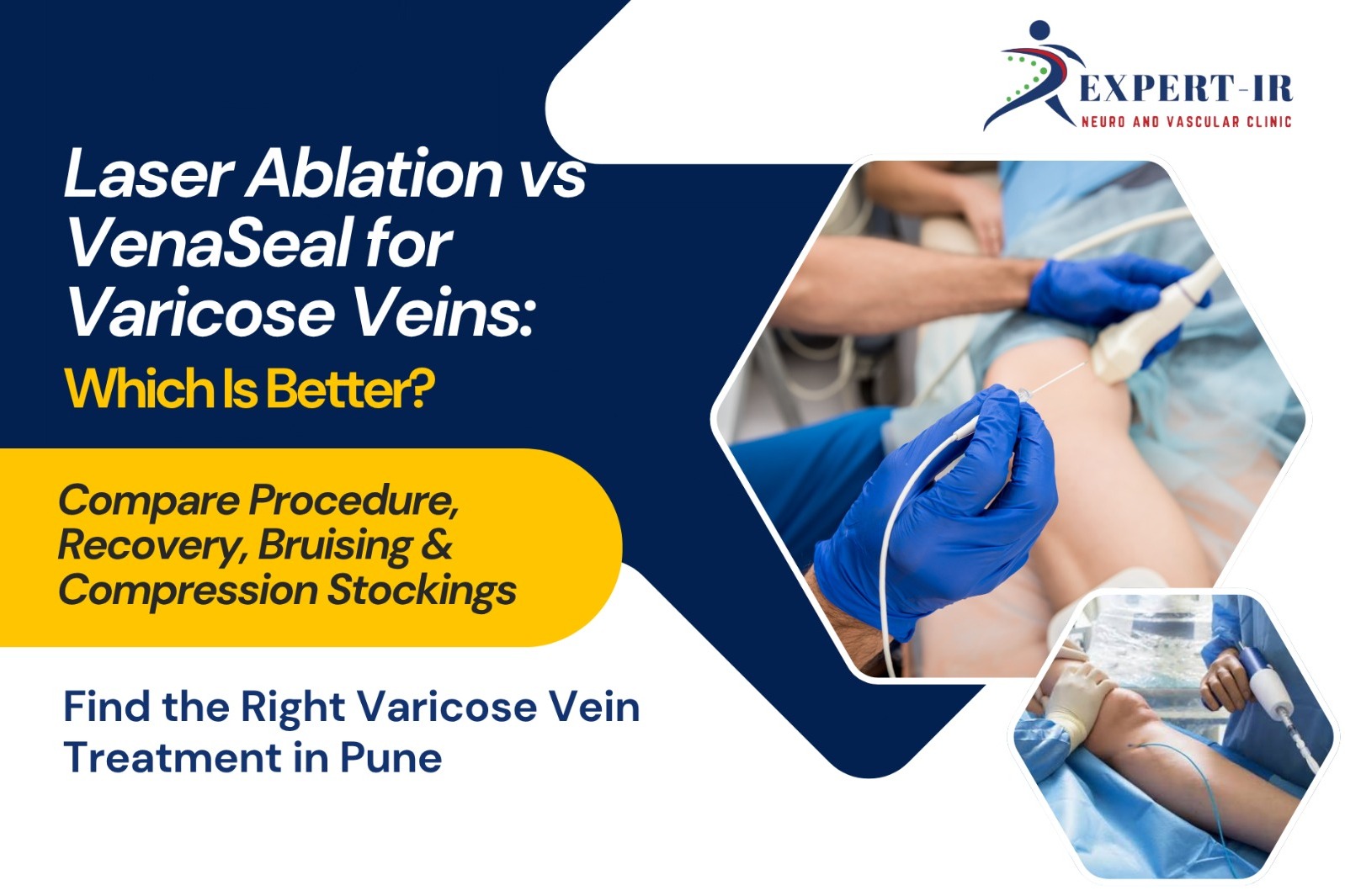
Laser Ablation vs VenaSeal for Varicose Veins: Which Is Better?
Compare Procedure, Recovery, Bruising & Compression Stockings
Find the Right Varicose Vein Treatment in Pune
Laser or VenaSeal? Depends mostly on anatomy and what the patient prefers, since both
actually work well for varicose veins, just through completely different methods.
Laser ablation threads a thin fiber into the affected vein, using heat to seal it shut from within.
Blood then reroutes naturally through nearby healthier veins. It's a proven technique with
solid long-term results, though it needs local anesthesia along the vein to manage the heat
involved.
VenaSeal skips heat entirely. A medical adhesive goes directly into the vein instead, sealing it
closed almost right away. No extensive anesthesia needed here, since there's no heat causing
discomfort along the treatment path.
Recovery looks a bit different between the two. Laser treatment usually calls for compression
stockings afterward, supporting healing and cutting down bruising. VenaSeal often skips that
step altogether, minimal tissue trauma means many patients get back to normal activity
almost immediately.
Bruising varies too. Laser can leave more bruising along the treated vein, a result of heat
affecting nearby tissue. VenaSeal tends to leave less visible bruising, given how differently it
works.
Neither wins outright. Vein size, location, overall vascular anatomy, all of it shapes which
technique actually fits a specific case better, and cost sometimes plays into the decision too.
Getting this right needs proper evaluation first. An experienced interventional radiologist in
Pune checks vein anatomy through ultrasound, then recommends whichever approach offers
the better outcome for that particular case.
Schedule a consultation with Dr. Santosh Patil to find out which treatment suits your
condition best.
Compare Procedure, Recovery, Bruising & Compression Stockings
Find the Right Varicose Vein Treatment in Pune
Laser or VenaSeal? Depends mostly on anatomy and what the patient prefers, since both
actually work well for varicose veins, just through completely different methods.
Laser ablation threads a thin fiber into the affected vein, using heat to seal it shut from within.
Blood then reroutes naturally through nearby healthier veins. It's a proven technique with
solid long-term results, though it needs local anesthesia along the vein to manage the heat
involved.
VenaSeal skips heat entirely. A medical adhesive goes directly into the vein instead, sealing it
closed almost right away. No extensive anesthesia needed here, since there's no heat causing
discomfort along the treatment path.
Recovery looks a bit different between the two. Laser treatment usually calls for compression
stockings afterward, supporting healing and cutting down bruising. VenaSeal often skips that
step altogether, minimal tissue trauma means many patients get back to normal activity
almost immediately.
Bruising varies too. Laser can leave more bruising along the treated vein, a result of heat
affecting nearby tissue. VenaSeal tends to leave less visible bruising, given how differently it
works.
Neither wins outright. Vein size, location, overall vascular anatomy, all of it shapes which
technique actually fits a specific case better, and cost sometimes plays into the decision too.
Getting this right needs proper evaluation first. An experienced interventional radiologist in
Pune checks vein anatomy through ultrasound, then recommends whichever approach offers
the better outcome for that particular case.
Schedule a consultation with Dr. Santosh Patil to find out which treatment suits your
condition best.
Keywords